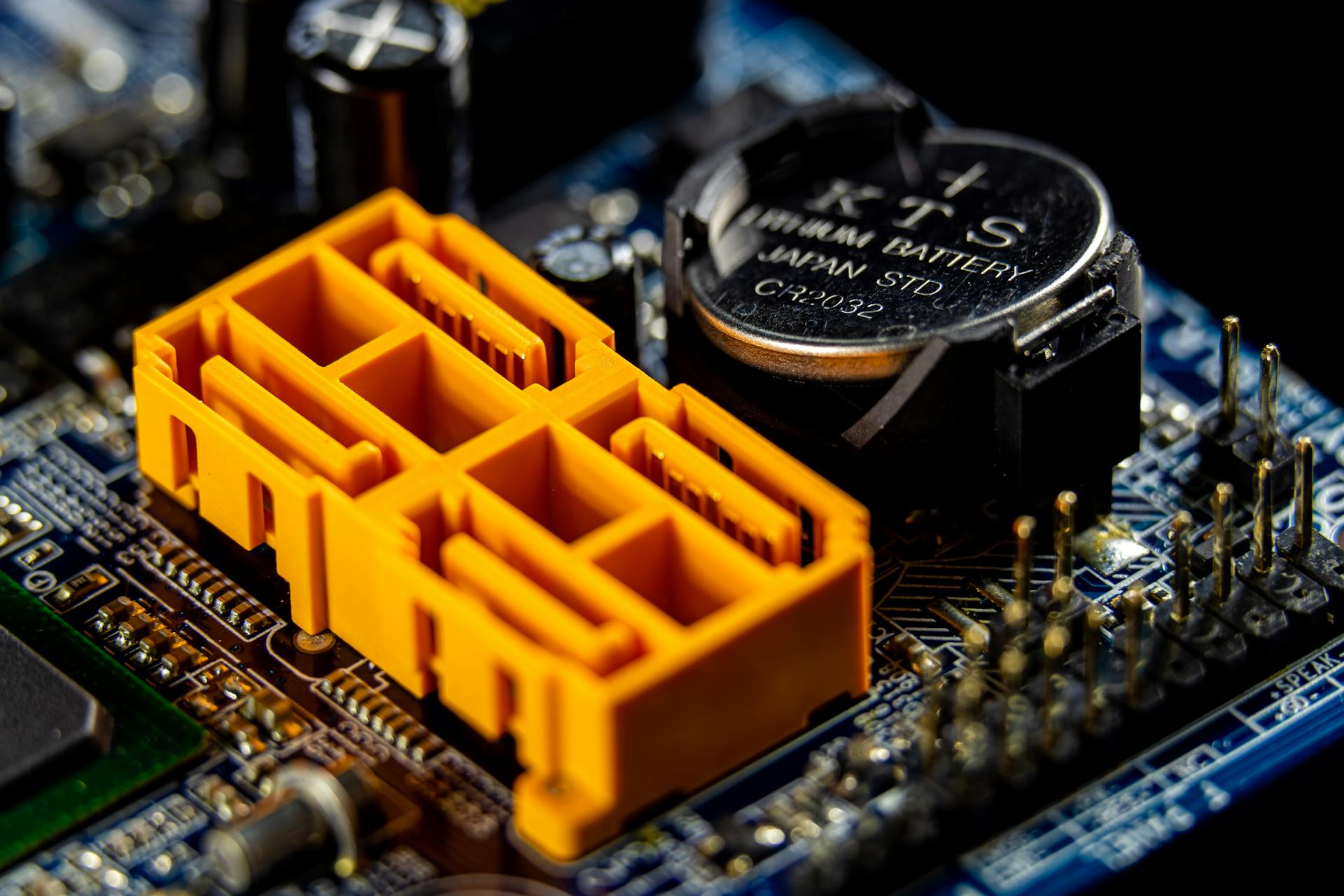
Computer organization is a crucial aspect of computer science, and Compsci 230 is a course that dives deep into this topic. The course covers the fundamental principles of computer design, including the trade-offs between different design approaches.
In Compsci 230, you'll learn about the different levels of computer organization, from the instruction set architecture to the physical components of the computer. This includes understanding the role of the memory hierarchy, which is responsible for storing and retrieving data quickly.
A key concept in Compsci 230 is pipelining, which is a technique used to improve the performance of computer systems by breaking down complex tasks into smaller, more manageable steps. By understanding how pipelining works, you'll be able to design more efficient computer systems.
The course also covers the topic of parallel processing, which involves using multiple processing units to perform tasks simultaneously. This is an important concept in Compsci 230, as it has significant implications for the design of modern computer systems.
You might enjoy: Compsci 110
Learning Outcomes
You'll be able to describe and use the features typically offered by an object-oriented programming language, including support for classes, visibility, inheritance, interfaces, polymorphism and dynamic binding.
Object-oriented programming languages support a range of features that enable you to write more efficient and scalable code. By learning these features, you'll be able to create more robust and maintainable software.
Here are the key features you'll learn about:
- Classes: a blueprint for creating objects
- Visibility: controlling access to object attributes and methods
- Inheritance: creating a new class based on an existing one
- Interfaces: defining a contract for a class to implement
- Polymorphism: using the same method name for different actions
- Dynamic binding: resolving method calls at runtime
You'll also learn how to create simple object-oriented design models, which will help you organize your code and make it easier to maintain. This involves separating concerns, using abstraction, and hiding implementation details.
To assess and improve software design decisions, you'll need to understand key design principles such as separation of concerns, abstraction, information hiding, programming to interfaces, coupling and cohesion, resilience to change, and reuse. By applying these principles, you'll be able to write more maintainable and scalable software.
By the end of this course, you'll be able to develop a small graphical user interface (GUI) based application in an object-oriented programming language. You'll also be able to assess and improve software design decisions based on object-oriented design objectives and principles.
Course Structure
The course starts with a discussion of data representation in C, but that's not what we're focusing on here.
The course is divided into several topics, including modern computer systems, data representation, and systems programming concepts.
Lectures will cover data representation, modern machine architecture, assembly, and the process abstraction.
Here are the specific topics and their corresponding dates:
Note that the course also includes a midterm exam, which will cover lectures 1-11, scheduled for Mo 2/19.
Regular office hours will end on December 12th, unless otherwise announced.
The course will also have discussion sessions, which will cover topics such as induction and graph theory.
Here are the discussion session topics and dates:
The final exam will be released at 12:01 am on Fr 5/1 and will be due at 11:59 pm Durham time.
Key Concepts
In compsci 230, you'll be working with Java, a programming language that's all about object-oriented programming. This means you'll be creating objects that can interact with each other in a more realistic way.
One key concept to grasp is inheritance, which allows you to create a new class based on an existing one, inheriting its properties and behavior. This is a powerful tool for building complex systems.
You'll also be working with nested classes, which are classes defined inside another class. This can help keep your code organized and easy to understand.
Here are some key concepts to keep in mind:
- Object-oriented programming
- Inheritance
- Nested classes
These concepts are fundamental to building robust and maintainable software, and will serve you well in your compsci 230 journey.
Binary Numbers
Binary Numbers are the foundation of computer programming, and understanding them is essential for any aspiring coder.
To work with binary numbers, you need to be able to perform basic arithmetic operations like addition, subtraction, multiplication, and division. This includes adding and subtracting binary numbers, which is similar to adding and subtracting decimal numbers, but with a base of 2.
Binary numbers can be converted among binary, decimal, and hexadecimal, which is useful when working with different types of data or systems. For example, a binary number can be converted to a decimal number, and then to a hexadecimal number.
Here's a quick rundown of the different types of binary number conversions:
Mastering these conversions will make you a more efficient and effective programmer.
Digital Logic
Digital Logic is a fundamental concept in electronics and computer science. It's all about using logic components to perform tasks.
You'll need to be able to identify basic logic components, such as AND, OR, and NOT. These are the building blocks of digital logic. Understanding how digital logic is implemented using transistors is also crucial.
To perform a task, you'll need to combine logic components. This can be done using various methods, including using clocking sequences. Clocking sequences help synchronize the logic components.
There are two main types of logic: combinational and sequential. Combinational logic is used to perform tasks based on the current input, while sequential logic is used to perform tasks based on the previous input.
Here's a quick summary of the types of logic:
You'll also need to understand the difference between level and edge triggered circuits. Level triggered circuits change state when the input signal reaches a certain level, while edge triggered circuits change state when the input signal crosses a certain threshold.
Processing Elements
The central processing unit (CPU) is the brain of your computer, and understanding its components is crucial to grasping how it works.
A CPU consists of several key components, including the arithmetic and logic unit (ALU), registers, and instruction decoder. These components work together to decode instructions, perform arithmetic operations, and store data.
The ALU is responsible for performing integer arithmetic, such as addition and subtraction. It's like having a super-fast calculator that can handle complex calculations in a split second.
Branching instructions are another important aspect of CPU processing. These instructions allow the CPU to make decisions based on conditions, such as whether a number is greater than or less than another number.
There are different addressing modes that the CPU uses to access memory. Some common addressing modes include immediate, register, and indirect addressing.
CPU registers are small amounts of memory that the CPU uses to read and write data. They're like a special kind of cache that helps the CPU access data quickly.
Here are some of the key components of a CPU and their functions:
Computer Components
Computer components are the building blocks of a computer, and understanding how they work together is crucial for anyone interested in computer science. A CPU can communicate with hardware through memory-mapped IO (MMIO) or port IO (PIO).
Memory-mapped IO allows the CPU to access hardware registers directly through memory addresses. This is useful for devices that need to be accessed frequently, like the keyboard or mouse. On the other hand, port IO is used for devices that don't need to be accessed as often.
Data transfers can be made without CPU involvement through direct-memory access (DMA). This is like a conveyor belt that moves data from one place to another without the CPU having to lift a finger. It's especially useful for transferring large amounts of data, like videos or images.
Dynamic RAM (DRAM) stores a single bit, which is a binary digit that can be either 0 or 1. A memory address translates into a row and column in a DRAM grid, allowing the CPU to access specific bits of data.
Devices can be connected through a bus, such as PCIe, SPI, I2C, or USB. Each bus has its own set of rules and limitations, but they all serve the same purpose: to enable communication between devices.
Here's a brief overview of some common computer components:
RISC-V ISA
In Compsci 230, we're diving into the world of RISC-V Instruction Set Architecture (ISA). To write an assembly program using RISC-V instructions, you need to understand the basics of the ISA.
The RISC-V ISA is built to be simple and efficient, making it easier to write and optimize code. This is a key advantage of the RISC-V architecture.
To write an assembly program, you'll need to know how to encode and decode RISC-V instructions. This involves understanding the structure of the instructions and how they're represented in binary.
Here's a breakdown of the components of an assembly program:
- Labels: used to identify specific locations in the code
- Directives: used to provide additional information to the assembler
- Instructions: the actual code that performs operations
Understanding these components is crucial to writing effective assembly programs.
Performance Optimization
Performance Optimization is a crucial aspect of computer science, and it's essential to understand the techniques that can help improve the performance of your code. To achieve this, you need to grasp the concept of pipelining, which allows multiple instructions to be executed simultaneously, increasing the overall throughput of your system.
Pipelining is a powerful technique that can significantly improve performance, but it's not without its challenges. One of the main issues is data hazards, which occur when the data required by an instruction is not yet available.
To overcome data hazards, you need to understand how to identify and address them. This involves understanding the different types of cache systems, including direct-mapped, set-associative, and fully-associative caches.
Here's a quick rundown of the key differences between these cache types:
In addition to understanding cache systems, you also need to be aware of the different cache write policies, including write-back and write-through. Write-back policies write data to the cache and then write it back to memory when it's no longer needed, while write-through policies write data directly to memory.
Basic branch prediction, or speculation, is another technique used to improve performance. This involves predicting the outcome of a branch instruction and executing the code accordingly.
Finally, understanding parallel processing, multiprocessing, and multi-core processing is essential for optimizing performance. These techniques allow multiple instructions to be executed simultaneously, increasing the overall throughput of your system.
Assessment and Projects
You'll have six assigned projects in Compsci 230, each requiring significant use of C and its associated tooling.
These projects allow you to collaborate with a single partner, sharing code freely, but only one of you should submit the work to Gradescope, indicating it's a group submission and identifying your partner.
You'll be provided with "starter" projects for some assignments, which will require you to add, modify, or complete various tasks, and most projects come with automated tests to guide you.
Remember to submit your projects to Gradescope, where they'll run an autograder and apply additional private tests, and some projects will also have a manually graded component called "project quiz."
Coding Expectations
In COSC230, students can expect to write several programs in C++ and RISC-V assembly. This will help you develop a strong foundation in programming.
You're expected to have a sufficient background in C++ and/or Java programming, so make sure you're comfortable with the basics before diving in. This will make it easier to tackle the coursework.
Code that doesn't compile or assemble will be penalized significantly. Don't worry if you make mistakes - the TAs are there to help, but they won't write the solution code for you.
Here are some specific guidelines to keep in mind:
- Students will write several programs both in C++ and RISC-V assembly.
- Students who take COSC230 are expected to have a sufficient background in C++ and/or Java programming.
- Code that does not compile or assembly will be penalized significantly.
Time Management
Time management is crucial to succeed in this course. You should plan to spend twelve to sixteen hours a week on this class, as it's a four-credit course.
In a typical week, you'll have a lot to do. You'll need to attend lecture, participate in in-class exercises, and read the associated lecture notes as needed.
You'll also need to attend lab, where you'll complete an exercise or worksheet, and occasionally take a project quiz. Don't forget to complete the lesson quiz, which allows for unlimited retries, and the timed weekly quiz.
One of the bigger tasks is completing the larger programming assignment, which is due every other week. Make sure to fit that into your schedule.
Optional, but recommended, is attending office hours to get extra help and support.
Projects
You'll be working on six assigned projects, each requiring significant use of C and its associated tooling. You're allowed to collaborate with a single partner on each project, sharing code freely with them.
To submit a group project, only one of you should make a single submission into Gradescope, and you should indicate it's a group submission using the interface Gradescope provides. You should also identify your partner.
For some projects, you'll be provided a "starter" project, which will require additions, modifications, or completion of various tasks. Most projects come with some automated tests to guide you.
You'll submit your projects to Gradescope, which will run our autograder and apply additional private tests; some projects will also have a manually graded component, called "project quiz."
Lesson Quizzes
Lesson quizzes are a regular part of this course, and it's essential to understand how they work.
You'll take a lesson quiz every week, and it's based on the lecture and assigned readings. These quizzes are 5-10 questions long and are true/false or multiple choice style.
Lesson quizzes are given through Moodle, and you'll need to get a 100% on each one before you can proceed to the next activity. Don't worry, you're allowed to take these quizzes as many times as you need until you get 100%. You can even collaborate with your peers, but make sure you understand the material yourself.
Here's a summary of what you need to know about lesson quizzes:
- They're given through Moodle
- They're based on the lecture and assigned readings
- They're 5-10 questions long and true/false or multiple choice style
- You need to get 100% on each one before proceeding
- You can take them as many times as you need until you get 100%
- Collaboration is allowed, but make sure you understand the material
What Is Permitted and What Is Not
Collaboration is allowed, but on exams, your submission must be entirely your own.
You can discuss material with others, but if collaboration is forbidden, your submission must be entirely your own. This includes exams, which are closed-book.
You may get help from current course members or specific University resources like CICS tutors or LRC SI leaders. This help includes designing algorithms, writing code, debugging, and developing test cases.
However, you may not get help from anyone who is not a current member of COMPSCI 230 or a specific University resource.
You may not provide your solutions to others, except when collaboration is explicitly permitted, like on problem sets and programming assignments.
You may not copy code from online sources, except from the current semester website or Moodle site. Copying code from another student or third party is a violation of academic honesty.
You may not use third-party online forums like StackOverflow to ask for specific help on assignments. You may not search for solutions online either.
It's good practice to ask for help by describing the problem or using a small synthetic example. If you must include a large chunk of your code, mark it as a "private" question, and only course staff will see it.
Featured Images: pexels.com