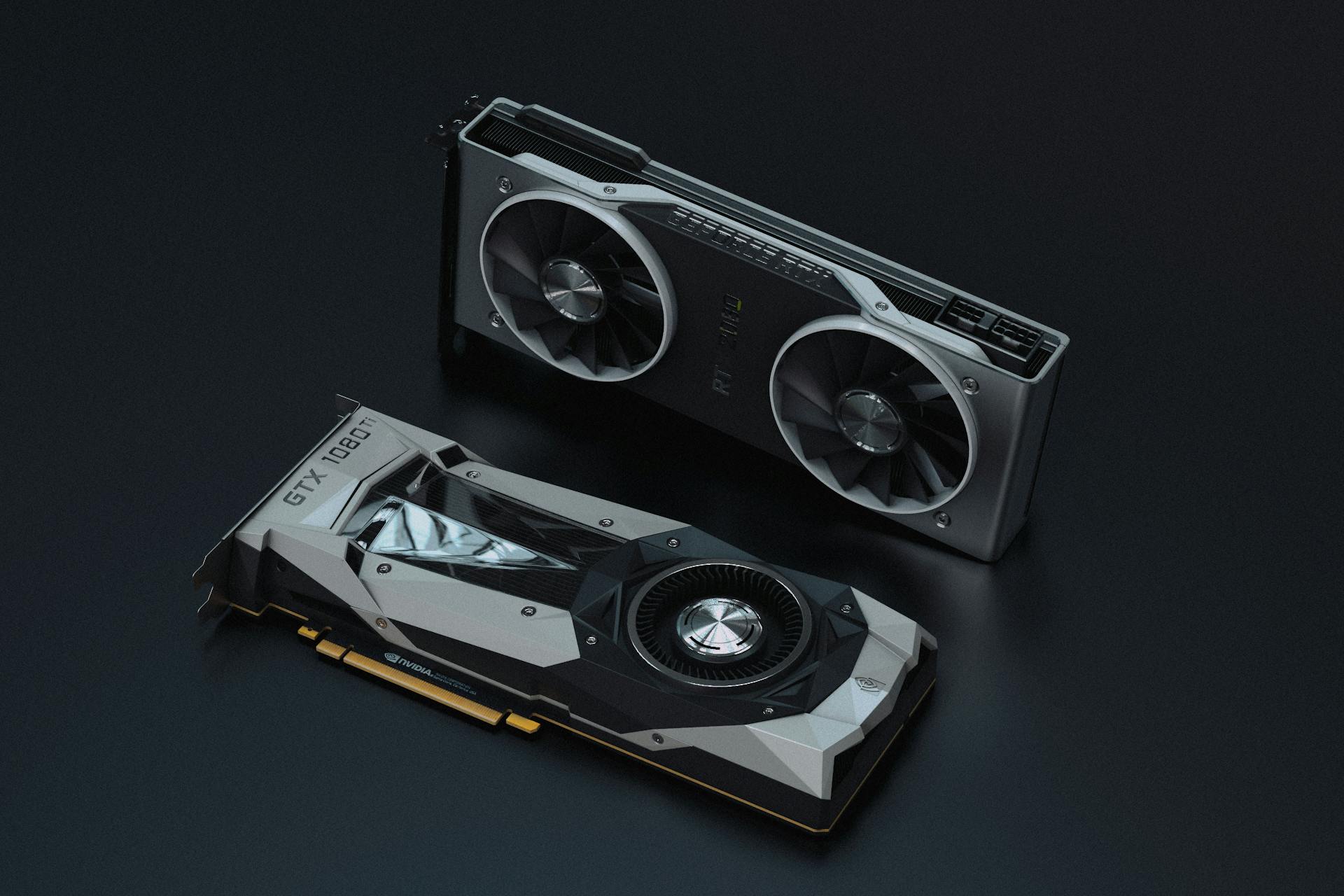
Genai perf has come a long way since its inception, and one of the key factors driving its growth is the use of advanced GPUs. These specialized computer chips are designed to handle the complex calculations required for genai perf.
By leveraging the power of these GPUs, developers can achieve significant performance boosts, with some reports showing up to 5x faster processing times. This is especially important for applications that rely on genai perf, such as AI development and data analysis.
One notable example of this is the use of NVIDIA's Tesla V100 GPU, which has been shown to provide a 4x increase in genai perf compared to traditional CPUs. This is a game-changer for industries that rely on AI and machine learning, such as healthcare and finance.
Discover more: What Is One of the Key Challenges Faced by Genai
GPU Optimization
Optimizing GPU performance is crucial for reducing AI deployment times and ensuring models operate at peak efficiency. This involves understanding the key benefits and strategies for maximizing GPU performance.
Choosing the right GPU is essential, as large neural networks benefit from GPUs with high core counts and large memory bandwidth. Benchmarking data helps compare GPU performance across similar tasks to choose the most suitable one.
Utilizing mixed precision training can significantly boost performance by reducing computational load, and GPUs with Tensor Cores can accelerate this process. This technique can speed up processing with minimal accuracy loss.
Here are some strategies for maximizing GPU performance:
By implementing these strategies, you can ensure efficient GPU operation, reduce operational costs, and enhance your competitive advantage.
Take a look at this: Ai Interview Software
Maximizing GPU Performance
Optimizing GPU performance is a strategic advantage that can give you a competitive edge in AI deployment. By enhancing the GPU efficiency and speed, you can better accelerate your model training.
Choosing the right GPU for your AI workload is crucial, as it involves understanding your model's computational needs. Selecting the right GPU requires benchmarking data to compare performance across similar tasks.
Optimizing GPU usage is essential for efficient GPU utilization. This involves managing data flow to keep the GPU continuously busy and tuning batch sizes to maximize performance without exceeding memory capacity.
Mixed precision training can significantly boost performance by reducing computational load. GPUs with Tensor Cores, like those from NVIDIA, can take advantage of this technique to speed up processing with minimal accuracy loss.
Parallelizing workloads across multiple GPUs can accelerate training by distributing processing tasks effectively among GPUs. This approach is particularly useful for large models that exceed a single GPU's memory capacity.
Efficient memory usage is key to GPU performance. Techniques like gradient checkpointing can reduce memory overhead during training by only storing essential data and recalculating as needed.
Here are some strategies to maximize GPU performance:
- Choose the right GPU for your AI workload.
- Optimize GPU usage by managing data flow and tuning batch sizes.
- Utilize mixed precision training to reduce computational load.
- Parallelize workloads across multiple GPUs.
- Optimize memory usage using techniques like gradient checkpointing.
- Profile and monitor performance to identify bottlenecks.
- Optimize algorithm and code for GPU execution.
- Leverage cloud GPU resources for scalable solutions.
TensorRT LLMs (VLLMs)
TensorRT LLMs (VLLMs) are a type of backend model that can be used with the "triton" service-kind. You currently must set exclude_input_in_output to true in the model config to not echo the input tokens in the output when using the TRT-LLM backend.
The default backend for TensorRT LLMs is tensorrtllm, but you can also use vllm as an alternative. This is specified in the backend field of the model configuration.
GPU Selection
Choosing the right GPU is a crucial step in achieving optimal genai perf. Selecting the right GPU involves understanding your model's computational needs, with large neural networks benefiting from GPUs with high core counts and large memory bandwidth.
To choose the right GPU, benchmarking data is essential for comparing GPU performance across similar tasks. This helps developers choose the most suitable GPU for their specific AI workload.
Here are some key factors to consider when selecting a GPU:
By considering these factors and choosing the right GPU for your AI workload, you can achieve optimal genai perf and ensure efficient GPU operation.
Driving Client Innovation
Generative AI is a game-changer for driving client innovation, offering new ways to boost productivity and fuel growth.
Perficient's expertise in harnessing this technology helps the world's best brands stay ahead and shape the future of their industries.
A robust framework addressing data management, ethics, and compliance is key to GenAI success, as Perficient's PACE Framework demonstrates.
This framework provides a holistic approach to AI governance, including establishing guidelines and implementing risk management.
Perficient's PACE Framework also includes increasing adoption through education and providing tools for responsible AI integration.
By staying ahead of the curve with GenAI, brands can remain agile and competitive in their respective markets.
Best GPUs for ML
Choosing the right GPU for machine learning (ML) and AI deployment can be a daunting task, but understanding your model's computational needs is key. This involves selecting a GPU with high core counts and large memory bandwidth, especially for large neural networks.
Benchmarking data is essential for comparing GPU performance across similar tasks to choose the most suitable one. This will help you find the perfect balance between performance and cost.
To maximize GPU performance, consider using mixed precision training, which reduces computational load by using lower precision where full precision isn’t necessary. This can significantly boost performance using GPUs with Tensor Cores, like those from NVIDIA.
For large models that exceed a single GPU's memory capacity, parallelizing workloads across multiple GPUs is a great option. This can be done using data parallelism to split training data or model parallelism.
Some of the best GPUs for ML and AI deployment in 2024 include:
These GPUs are ideal for tasks that require high computational power and large memory capacity. However, it's essential to consider your specific needs and budget before making a final decision.
NVIDIA H100
The NVIDIA H100 is a state-of-the-art GPU designed for next-gen AI and ML workloads.
It features 16,896 CUDA cores, making it a powerhouse for large-scale AI training and inference.
Built on the Hopper architecture, the H100 is ideal for complex simulations and accelerating transformer models.
Unparalleled performance in data centers and HPC environments is what the H100 excels at.
With up to 80 GB of HBM3 memory, the H100 can handle even the most data-intensive applications.
It's designed to provide exceptional performance for large-scale AI training, making it a top choice for those in the field.
Additional reading: Nvidia Genai
NVIDIA A10
When choosing a GPU for AI inference, consider the NVIDIA A10, which boasts 9,216 CUDA cores. This makes it an excellent choice for demanding tasks.
The A10 also features 288 Tensor Cores, which are optimized for AI workloads. This unique design allows for faster processing of complex AI models.
For data centers, the A10's 24 GB of GDDR6 memory provides ample storage for handling large datasets. This is especially useful for data science applications that require significant memory resources.
Model Selection Strategy
When multiple models are specified, a specific model is assigned to a prompt using a model selection strategy.
The default model selection strategy is round robin, which means each model receives a request in order. This approach ensures that all models are utilized equally.
Alternatively, you can use a random model selection strategy, which assigns models to prompts uniformly at random.
GPU Performance Metrics
GPU performance metrics are crucial for evaluating the efficiency of your GenAI-Perf tool. GenAI-Perf collects a diverse set of metrics that captures the performance of the inference server.
The metrics collected by GenAI-Perf include Time to First Token, Inter Token Latency, Request Latency, Output Sequence Length, Input Sequence Length, Output Token Throughput, and Request Throughput. These metrics provide valuable insights into the performance of your GenAI-Perf tool.
Here are the metrics with their descriptions and aggregations:
Metrics for Measuring GPU
Metrics for Measuring GPU Performance are crucial for understanding how well your GPU is performing. You can collect metrics like output token throughput, time to first token, inter-token latency, and request throughput using tools like GenAI-Perf.
Output token throughput is a key metric, measuring the total number of output tokens from a benchmark divided by benchmark duration. Request throughput, on the other hand, measures the number of final responses from a benchmark divided by benchmark duration.
GenAI-Perf is a command-line performance measurement tool that collects metrics useful for analyzing an LLM's performance. These metrics include output token throughput, time to first token, inter-token latency, and request throughput.
Time to first token is the time between when a request is sent and when its first response is received, one value per request in benchmark. Inter-token latency measures the time between intermediate responses for a single request divided by the number of generated tokens of the latter response.
Here's a list of metrics collected by GenAI-Perf:
- Output token throughput
- Time to first token
- Inter-token latency
- Request throughput
These metrics help analyze system performance, determine how quickly the system starts processing the request, provide the overall time taken by the system to completely process a request, and retrieve a granular view of how fast the system can generate individual parts of the response.
P<int>#
The time interval used for each measurement is crucial in understanding GPU performance.
The time interval is specified in milliseconds, and Perf Analyzer will sample a time interval specified and take measurement over the requests completed within that time interval.
For example, if you set the time interval to 10000 milliseconds, Perf Analyzer will take a measurement over the requests completed within that 10-second time frame.
The default time interval is 10000 milliseconds, which is a good starting point for most measurements.
You can adjust the time interval to suit your specific needs, but keep in mind that a shorter interval may result in more frequent measurements, which can be beneficial for real-time analysis.
Featured Images: pexels.com