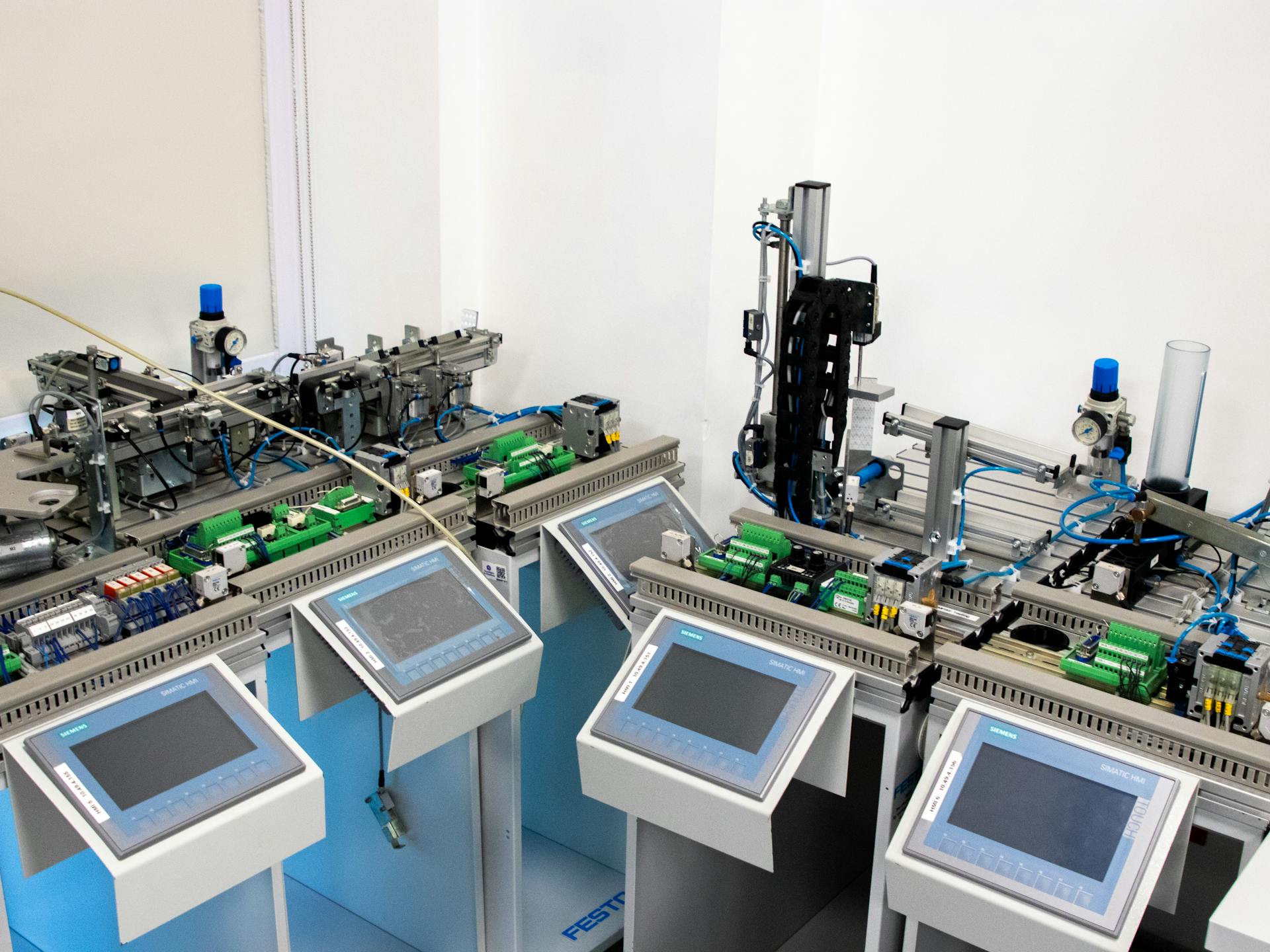
Intelligent automation is transforming the way businesses operate, and it's not just a buzzword - it's a game-changer.
According to a study, 61% of organizations have already implemented intelligent automation, and this number is expected to rise to 80% by 2025.
Companies are leveraging intelligent automation to streamline processes, reduce costs, and improve efficiency. For instance, a leading bank automated its customer service operations, resulting in a 30% reduction in response times.
By automating routine tasks, employees can focus on higher-value tasks that require creativity, problem-solving, and human touch. This shift in focus has led to improved customer satisfaction and employee engagement.
Intriguing read: Evaluation of Binary Classifiers
What Is Intelligent Automation?
Intelligent automation is software technology that incorporates AI and ML to automate complex workflows. It's an extension of traditional RPA, designed to broaden its capabilities. Intelligent automation can automate tasks that previously required human involvement, like document understanding and unstructured data analysis.
This technology can process thousands of invoices 90% faster and with utmost accuracy, reduce tedious paperwork associated with claims processing by 95%, and enhance customer interactions through personalized responses. It can also reduce delays and improve delivery accuracy, optimizing supply chain management.
Intelligent automation applies robotic process automation (RPA) and other technologies, including AI, machine learning, natural language processing, low-code process automation, and generative AI tools to complex processes. It aims to automate tasks from beginning to end, reducing human effort, minimizing manual errors, and increasing efficiency.
Some benefits of intelligent automation include:
- Processing thousands of invoices 90% faster and with utmost accuracy.
- Reducing tedious paperwork associated with claims processing by 95%.
- Enhancing customer interactions through personalized responses and efficient problem resolution.
- Reducing delays and improving delivery accuracy, optimizing supply chain management.
- Optimizing production processes, leading to increased productivity and cost savings.
- Acting as a bridge across various discrete systems, seamlessly orchestrating work between software bots and humans.
Benefits of Intelligent Automation
Intelligent automation can significantly boost efficiency and productivity, freeing up employees for more strategic and creative work. This is because automation of routine tasks leads to significant boosts in efficiency and productivity.
By automating routine tasks, businesses can reduce the risk of human errors entering processes. Digital workers can automatically cross-check systems for compliance assurance, and they standardize and document processes for easier auditability.
Intelligent automation can reduce costs by 75% in the financial services industry, according to a study by KPMG. This is because digital workers can drastically lower overhead costs.
The faster your company is able to produce results, the higher the revenue you'll likely be able to generate. You'll also be paying less per project by automating the repetitive tasks that take too much time.
Robots aren't prone to human error or distraction, so they can carry out tasks faster and with greater accuracy. This means less time spent fixing mistakes and playing catch up afterwards.
Here are some key benefits of intelligent automation:
- Increased Efficiency and Productivity
- Error Reduction and Enhanced Work Quality
- Insights Generation and Trend Prediction
Intelligent automation can also improve customer satisfaction by providing quicker response times, and enable employees to focus on more complex and creative work. This can lead to higher productivity levels amongst your team.
Use Cases for Intelligent Automation
Intelligent automation has a wide range of applications across various industries. In the financial services sector, IA automates tasks such as customer onboarding, fraud detection, and compliance monitoring.
IA is particularly useful in the banking and finance sector, where it automates account management, invoice processing, and financial reporting, minimizing errors and expediting financial close cycles. Similarly, in the insurance sector, IA revolutionizes key processes including policy management, claims processing, and underwriting.
IA has almost unlimited applications, including customer service, manufacturing, healthcare, and more. Here are some examples of use cases for intelligent automation:
Use Cases
Intelligent automation has far-reaching applications across various industries. Intelligent automation in financial services can automate customer onboarding, fraud detection, sanctions screening, and due diligence checking, among other tasks.
From customer service to insurance companies, intelligent automation can streamline processes such as renewals, midterm adjustments, underwriting, and claims adjustment. In the healthcare industry, IA can automate revenue cycle processes, patient experience, and prior authorization processing.
In manufacturing, intelligent automation can automate production line monitoring, quality control, and inventory management, leading to increased productivity and cost savings. Retailers can use IA to enhance customer experiences, personalize services, and prevent fraud.
Here are some use cases for intelligent automation:
- Customer onboarding
- Fraud detection
- Sanctions screening
- Due diligence checking
- Mortgage or loan calculations
- Application processing
- Intelligent contact centers
- Renewals
- Midterm adjustments
- Underwriting
- Claims adjustment
- Settlements
- Compliance
- Back-office processes
- Revenue cycle automation
- Patient experience and engagement
- Patient processing
- Prior authorization processing
- Insurance claim automation
- Electronic health records
- Quote management
- Parts and product tracking
- Account and order management
- Performance reporting
- Auditing
- Data management
- Employee onboarding and exit
- Contact center transformation
- Back-office processes
- IT management
- Network security and configuration
- Cybersecurity
- Performance monitoring
- Customer experience and service
- Personalization
- Price matching
- Returns
- Contact center
- Customer insight
- Data collection
- Forecasting and reporting
- Fraud prevention
- Order fulfillment
- Stock tracking
- Employee onboarding and exit
- Citizen experience
- Data security
- Contact center
- Employee experience
- Employee onboarding and exit
- Data tracking
- Accounts payable and receivable
- Cybersecurity
- Reconciliation
- Account management
- Invoice processing
- Expense management
- Financial reporting
- Shipment tracking
- Scheduling
- Freight requests
- Predictive maintenance
- Data aggregation
- Cybersecurity
- Trend analysis
- SAP operations
Utilities and Energy
Utilities and Energy companies can greatly benefit from Intelligent Automation. Intelligent Automation can help with customer service, handling complaints, and planning maintenance.
With Intelligent Automation, companies can streamline their processes and reduce manual errors. For example, it can help with meter readings collation and consumption checks.
Intelligent Automation can also improve billing and payments, making it easier for customers to pay their bills on time. This can lead to increased customer satisfaction.
By automating tasks such as asset management and auditing, companies can reduce costs and improve efficiency. Intelligent Automation can also help with contract management and compliance.
Here's a list of some of the key areas where Intelligent Automation can make a big impact in Utilities and Energy:
- Customer service
- Complaints management
- Maintenance planning
- Asset management
- Billing and payments
- Meter readings collation
- Consumption checks
- Compliance
- Auditing
- Contract management
Technologies Used in Intelligent Automation
Intelligent automation is a powerful combination of technologies that work together to streamline complex processes and enable real impact for businesses.
RPA, or Robotic Process Automation, is a key component of intelligent automation, and it's great at working through simple, repeating tasks.
Natural language processing (NLP) is another technology used in intelligent automation, allowing it to understand and interpret human language.
Artificial intelligence (AI) powers the decision-making capabilities of IA solutions with machine learning, analyzing data to develop a vast knowledge base.
Business process management (BPM) is also a crucial part of intelligent automation, helping to manage and optimize business processes.
Machine learning (ML) is used to analyze data and make predictions, enabling intelligent automation to automate tasks that once needed to be performed by humans.
Process discovery and process mining are also used in intelligent automation, helping to analyze and optimize business processes.
Here's a list of the key technologies used in intelligent automation:
- RPA
- Natural language processing (NLP)
- Artificial intelligence (AI)
- Business process management (BPM)
- Machine learning (ML)
- Process discovery
- Process mining
Implementation and Management
With intelligent automation, you can efficiently manage and deploy bots across your enterprise.
Nividous Control Center is highly scalable and secure, allowing you to schedule, manage, and control your enterprise-wide automation easily.
Scalability is a key benefit of IA solutions, ensuring that companies can handle increased volumes of tasks without significant manual intervention or resource allocation.
The Nividous Control Center also effectively orchestrates work between humans and bots with an intuitive human-in-the-loop interface for real-time automation monitoring.
Our experts provide complete life-cycle professional services to ensure the successful deployment of IA solutions in complex environments.
These services are provided in 4 phases – Discovery, Implementation, Maintenance, and Center of Excellence (CoE) – empowering users with the skills to manage their solutions.
With the help of Nividous Control Center, you can monitor bots in real-time with a detailed audit trail and access control, giving you complete visibility and control over your automation processes.
The Future of Intelligent Automation
Intelligent automation is revolutionizing the way businesses operate, and it's not just about automating tasks – it's about optimizing processes and achieving operational excellence.
With intelligent process automation software, organizations can efficiently operate, overcome business challenges, and meet their needs. This is made possible by combining BPM and RPA with AI and ML.
In the highest stage of intelligent automation, algorithms learn by themselves and through interactions, empowering businesses to achieve Autonomous Process Optimization. They can identify inefficiencies and predict changes, risks, or opportunities.
This is where the power of AI comes in, enabling systems to comprehend, learn, and evolve. AI comprises various subfields, including machine learning, natural language processing, and cognitive computing.
Machine learning empowers systems to learn from their experiences and enhance their performance gradually. Natural language processing enables them to comprehend and produce human language, facilitating more natural and intuitive interactions with users.
In the future of intelligent automation, we can expect to see more advanced algorithms that can tackle intricate problems and make context-based decisions, just like human thought processes.
Consider reading: Human in the Loop Automation
Frequently Asked Questions
What is the main purpose of IPA?
IPA's main purpose is to automate manual, repetitive, and routine tasks, freeing up human workers to focus on higher-value tasks. By combining AI, ML, and automation technologies, IPA enhances productivity and efficiency in various industries.
Featured Images: pexels.com