The Recurse Center is a unique community of programmers and learners that offers a truly immersive experience. It's a place where you can focus on learning and growing without distractions.
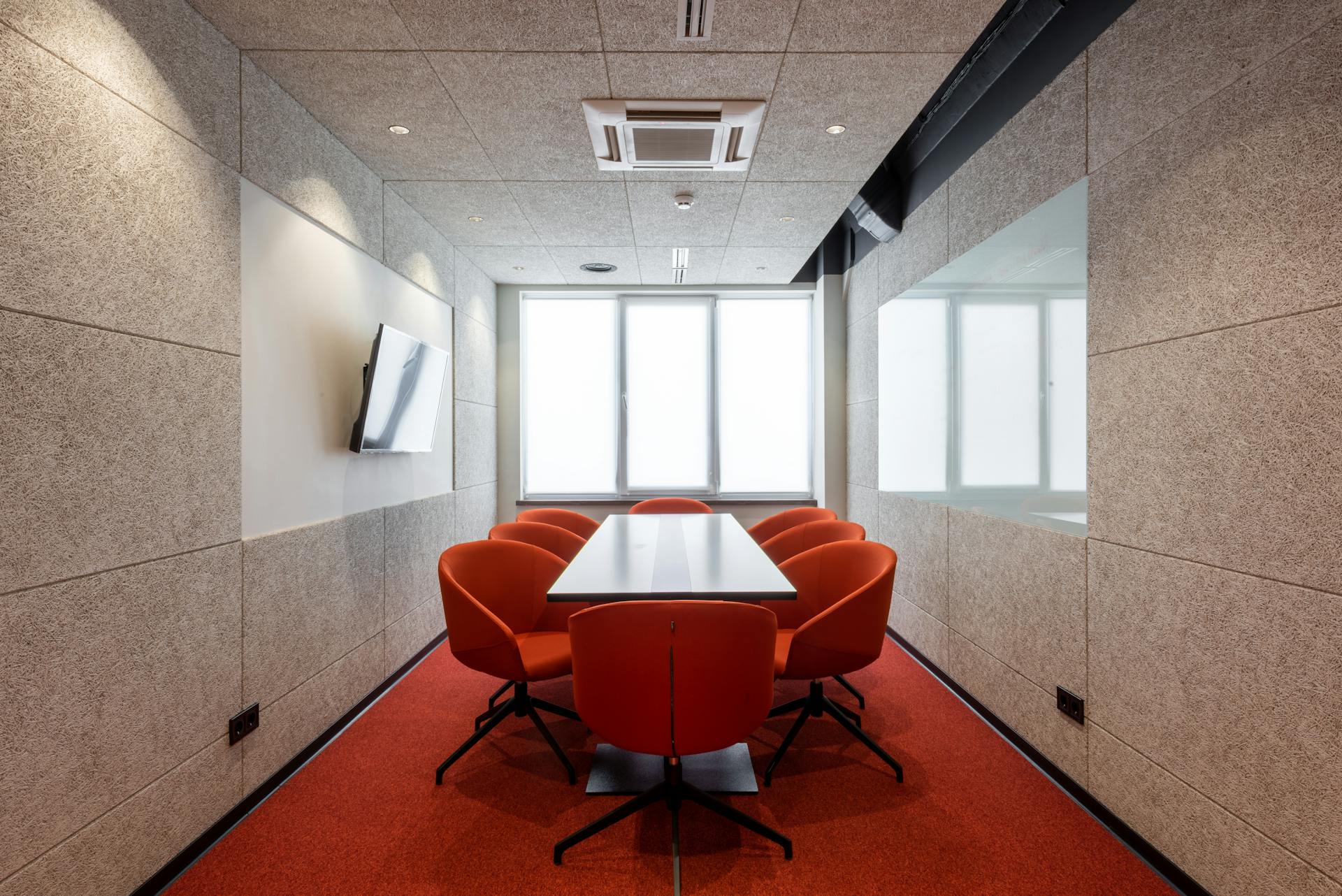
Located in New York City, the Recurse Center has a simple and elegant space that fosters collaboration and creativity. The center is open 24/7, allowing members to work and learn at their own pace.
Each week, the Recurse Center hosts a series of events and workshops that cater to different interests and skill levels. These events are designed to be informal and engaging, making it easy to meet new people and learn from them.
For your interest: Ap Comp Sci Unit 2
History
The Recurse Center has a fascinating history that spans over a decade. It was initially founded in the Summer of 2010 as Hackruiter, an engineering recruiting company, using seed money from Y Combinator.
The idea of transforming recruiting for start-ups by running a retreat as part of the process quickly arose, with the goal of helping clients become better programmers. This vision paved the way for the Center's future growth.
In July 2011, the Center officially opened its doors as "Hacker School" in New York, cleverly anticipating the coding bootcamp movement that emerged in the mid-2010s.
By mid-2012, Hacker School had gained significant public attention, thanks to its partnership with Etsy to offer "Hacker Grants" in support of female developers. Several companies soon joined Etsy in funding these grants.
In 2014, the grant program expanded to support other groups underrepresented in American technology industries. This move marked a significant milestone in the Center's commitment to diversity and inclusion.
The Center underwent a name change in 2015, rebranding itself as the Recurse Center. Despite the change, the Center's mission and values remained the same.
Here are some of the programs offered by the Recurse Center:
- a "residents" program for shorter-term specialist guidance
- a “maintainers” program to promote contribution to open-source software projects
Program Structure
The program structure at Recurse Center is designed to be flexible and accommodating. This is reflected in the fact that students can attend on a drop-in basis, allowing them to come and go as they please.
Recurse Center's program structure is also influenced by its non-traditional approach to learning, which emphasizes self-directed learning and peer-to-peer mentorship. This is in contrast to more traditional coding bootcamps, which often have a set curriculum and rigid schedule.
The drop-in model allows students to focus on their own learning goals and work at their own pace, which can be a big advantage for those who are self-motivated and disciplined.
Related reading: Sylvan Learning Center Rates
Pairing Workshop
A pairing workshop is a great way to practice working with others, especially if you're a self-learner like me. I had the chance to participate in one, and it was really helpful.
In a pairing session, one person is the driver and the other is the navigator. The driver writes the code, while the navigator observes and shares their thoughts to correct errors.
The driver should talk through their steps, and the navigator should focus on the big picture. It's also a good idea to switch roles mid-way through the pairing session.
Here are some tips to keep in mind while pairing:
- Don't talk over each other.
- Don't get defensive if an error is pointed out.
- Don't pair on something that's trivial to both participants.
If you're looking for a pairing partner, there's a pairing bot on Zulip that can randomly match you with someone. You can also post a task in the dedicated pairing stream and ask for collaborators.
Beyond the Personal Journey: Programming Bits
The Recursers are following a batch's database internals study group, which will likely involve learning about database internals at a low level.
Learning about database internals can be a complex task, but starting with the Red Book is a great place to begin.
Formal methods, specifically TLA+, are also on the agenda for some Recursers. This involves diving into the world of formal methods and learning how to use TLA+.
To get started with TLA+, some Recursers are following Hillel Wayne's newsletter and planning to go through his Learn TLA+ tutorial.
Here are some programming languages that Recursers are interested in learning about:
- Zig, with its first-class C-interop
- Rust, for building an NLP library
Zig is a language that Recursers find interesting because of its C-interop capabilities, and some are even planning to reimplement the bytecode interpreter from the Crafting Interpreters in Zig.

Real-time graphics programming is another area that Recursers are interested in, although it's not as clear if they will have time to pursue it.
Building an NLP library in Rust is a massive undertaking, but Recursers are willing to give it a try, starting with a word tokenizer, an algorithm to segment sentences, and a part-of-speech tagger.
Business and Philosophy
The Recurse Center is a unique organization that has found a way to sustain itself financially while still offering a free programming retreat to admitted applicants. It supports itself through recruitment, partnering with companies like Airtable and OpenAI to place participants in programming jobs.
This approach has proven successful, as the retreat reached the "tipping point" of self-sufficiency in 2014, generating enough income to cover its internal costs. Those costs are reported to be nearly $12,000 per participant, which covers expenses like facilitators who help with day-to-day operations and participant support.
The organization's business model is centered around providing value to both participants and partner companies, creating a win-win situation that allows it to thrive.
Business Model
The business model of a successful organization can be a fascinating topic. It's free of charge for admitted applicants to attend a programming retreat, making it an attractive opportunity for those looking to improve their skills.
The organization itself is for-profit, which means it generates income through various means. One of its main revenue streams is recruitment, where it places participants in programming jobs with partner companies.
These partner companies include Airtable, Notion, Hudson River Trading, Jane Street, and OpenAI. The retreat reached the "tipping point" of self-sufficiency in 2014, purely from recruiting income.
Internal costs to the company are reported to be nearly $12,000 for each participant. This cost is likely incurred for the day-to-day shepherding of participants and improvement of the organization itself, which includes "facilitators" for these tasks.
Educational Philosophy
The Recurse Center, a pioneer in self-directed learning, was inspired by the Unschooling philosophy of John Holt, who believed in a child-led approach to education. This philosophy is reflected in the Recurse Center's model, where participants create their own learning structure.
The Recurse Center is not a traditional school, and its name change in 2015 was a deliberate attempt to avoid confusion. The original name "Hacker School" was meant to convey a sense of technical resourcefulness and community support, rather than the popular notion of hacking as breaking into computer systems.
In this sense, the Recurse Center's approach to learning is quite different from traditional educational settings. By allowing participants to take ownership of their learning, the Recurse Center fosters a sense of autonomy and creativity.
If this caught your attention, see: Kumon Learning Center Rates
Social Environment
The Recurse Center has a unique social environment that sets it apart from other programming communities. This is largely due to its formalized expectations of participant behavior, which were first published in June 2017.
The Center's social rules are a key feature of its community, and they've been adopted by other programming communities as well. These rules are designed to help participants focus on programming and avoid distractions.
The four light-weight social rules at the Recurse Center are straightforward and easy to follow. They include no feigning surprise, no well-actually's, no back-seat driving, and no subtle-isms.
Here are the four social rules in detail:
- No feigning surprise: This means being honest about what you know and don't know, without pretending to be surprised by someone's lack of knowledge.
- No well-actually's: This rule encourages participants to avoid interrupting others to correct them on minor points that aren't relevant to the conversation.
- No back-seat driving: If you want to help someone with a problem, engage with the problem entirely, rather than making sporadic or intermittent contributions.
- No subtle-isms: Be mindful of indirect or subtle forms of racism, sexism, ageism, and other biases, and try to avoid language or actions that could be perceived as discriminatory.
Breaking these rules is not the end of the world, and it's okay to make mistakes. What's important is being open to feedback and carrying on with the conversation in a constructive way.
Virtual RC
Virtual RC is a social place that gives a snapshot of where each Recurser is currently situated, whether they're at their virtual desk or in a meeting.
It's a real-time view of where your fellow Recursers are at, and if you find others in a meeting, you can check out the event and decide if you want to join.
Virtual RC is aimed at facilitating serendipitous, synchronous, and ephemeral interactions that would naturally happen in person.
The Recurse Center's core hours are from 11am to 5pm EST, which can be a challenge for those in different time zones, like me, who had to stay up till the wee hours of the morning.
Unfortunately, the back-to-back Zoom meetings during this time left me with very little bandwidth to do my own work.
Alumni and Impact
Recurse Center has had a significant impact on the tech industry through its notable alumni.
Timnit Gebru, who attended Recurse Center in Summer 2012, is now an AI ethics researcher.
Greg Brockman, another Summer 2012 attendee, co-founded OpenAI.
Paul Biggar, who attended in Fall 2016, co-founded CircleCI.
Andrew Kelley, creator of Zig, also spent time at Recurse Center.
Michael Nielsen, a quantum physicist, attended Recurse Center in Summer 2012.
Raph Levien, the creator of Advogato, attended in Fall 2017.
Why RC?
I've spent close to 8 years programming professionally, and while it's been a blessing to explore many areas of ML and adjacent fields, I've often felt pressure to learn just enough to build a new feature or product quickly.
This pressure to constantly learn new things, without time to explore them in depth, can be overwhelming.
Recurse Center aims to provide a solution to this problem by giving people the time and space to learn things in depth, without externally imposed deadlines.
Why RC?

I've spent nearly 8 years programming professionally, and it's been a blessing and a curse.
I've worked in ML-adjacent roles at startups, which has allowed me to explore many different areas, including machine learning, NLP, backend development, data pipelines, and infrastructure.
This experience has given me a sense of what it's like to be under pressure to learn something quickly, just enough to build a new feature or product fast.
The pressure to learn at a rapid pace has made me feel like I've been playing tetris while running on a treadmill.
I've often felt like I needed to learn everything yesterday, and that's exactly what RC aims to provide – a chance to learn things in depth, without external deadlines.
RC aims to provide a community, which is a crucial aspect of learning in depth.
Most importantly, RC offers a chance to hit pause, take a breath, and invest time into exploring topics without feeling rushed.
Why Now?

I've been thinking about applying to RC for a while, but never felt it was the right time.
The application requires a full-time commitment of 6 or 12 weeks, which means taking a break from work.
Several months ago, I discovered a blog that had a link to the RC application in the footer.
This was a big motivator for me to finally apply.
I met someone at PyCon US who encouraged me to apply and offered to answer my questions about RC.
Having a supportive network can make a big difference in our decisions.
My personal experience over the past couple of years has helped me develop a growth mindset, making me feel like RC would be a good fit now.
This mindset shift has given me the confidence to take on new challenges.
RC Is Awesome
Debugging is a fun and interesting process, as many RC alumni can attest to. It's an essential skill to learn, and RC provides a great environment to practice it.

Some of the most important things I learned at RC were related to systems, networking, and Linux. I was surprised to find out how cool and accessible these topics are, even for those with limited C programming knowledge.
RC alumni often mention the excitement of discovering new tools and concepts, such as netcat, strace, and system calls. These unknown-unknowns can be just as fascinating as they are useful.
Writing about what you're learning is a great way to reinforce your understanding and share your experiences with others. Many RC alumni have found this to be a fun and rewarding experience.
Here are some of the key takeaways from RC that can be applied to real-world problems:
- Debugging is a valuable skill that can be developed through practice and experience.
- Systems, networking, and Linux are accessible and cool topics to learn, even for beginners.
- Unknown-unknowns, such as netcat and strace, can be just as fascinating as they are useful.
- Writing about what you're learning can help reinforce your understanding and share your experiences with others.
Frequently Asked Questions
How much does the recurse center cost?
The Recurse Center is free for everyone, with no costs or fees to attend.
What programs are like the recurse center?
Other programs similar to the Recurse Center include Codeup, The Grace Hopper Program, Flatiron School, Ada Developer Academy, Hackbright Academy, and Skillcrush, as well as GirlDevelopIt, which offer immersive coding experiences and community-driven learning environments. These programs provide alternative paths for learning to code and connecting with like-minded individuals.
Featured Images: pexels.com