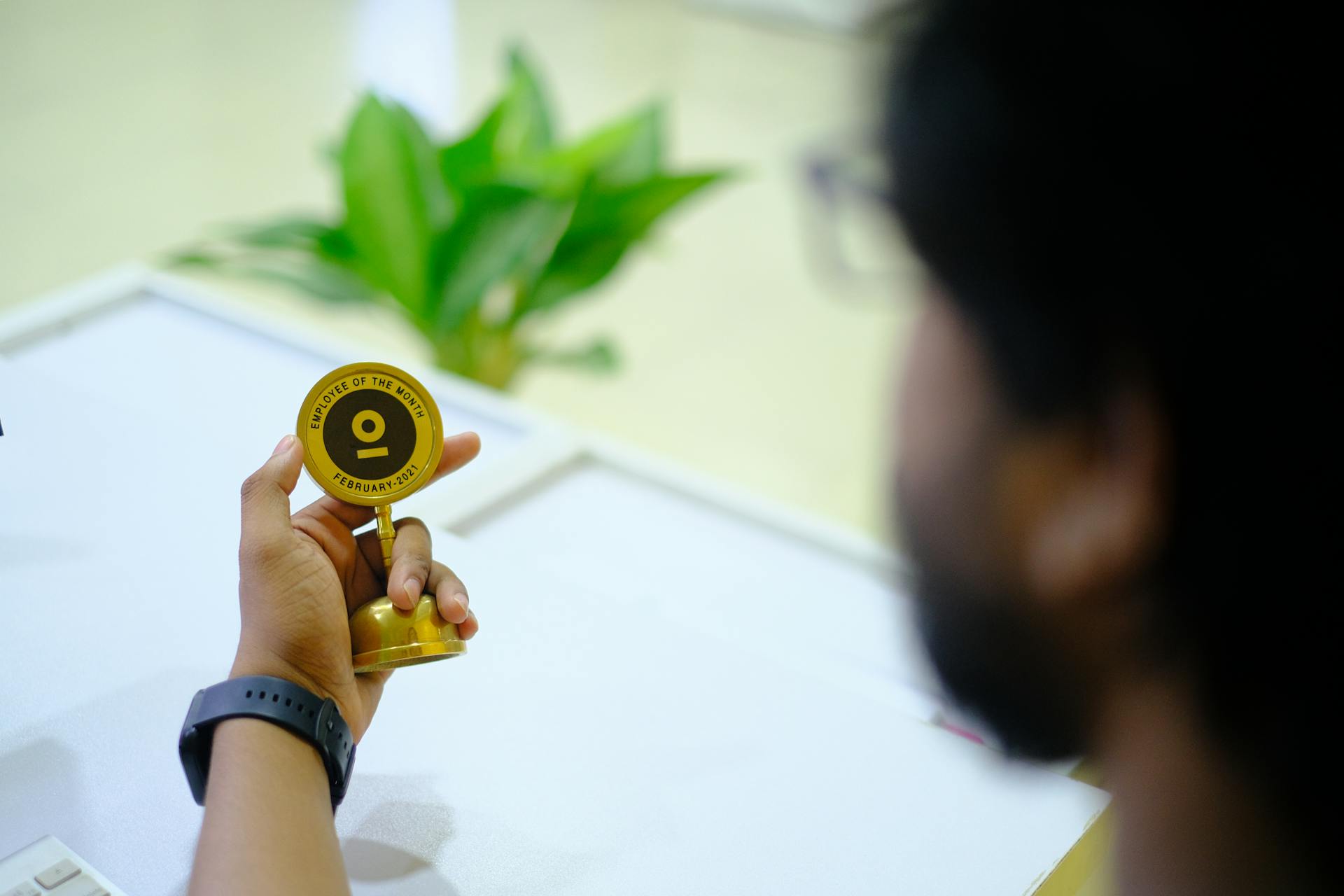
The IJCAI Computers and Thought Award is a prestigious recognition in the field of artificial intelligence. The award was established in 1971 by the International Joint Conference on Artificial Intelligence (IJCAI).
The first winner of the award was John McCarthy, a pioneer in the field of AI research. McCarthy's work laid the foundation for the development of the Lisp programming language.
The award is given to individuals who have made significant contributions to the field of AI, with a focus on the intersection of computer science and cognitive science. The winners are selected by a committee of experts in the field.
The award is named after the conference where it was first presented, and it has since become a highly respected honor in the AI community.
Curious to learn more? Check out: Genai Search
IJCAI Awards
The IJCAI Computers and Thought Award is a prestigious honor that recognizes outstanding young scientists in artificial intelligence. It was established with royalties from the book "Computers and Thought", edited by Edward Feigenbaum and Julian Feldman.
Past winners of this award have made significant contributions to the field of artificial intelligence. They include Terry Winograd, who received the award in 1971, and Patrick Winston, who received it in 1973.
The award is presented at IJCAI conferences to outstanding young scientists. It's currently supported by income from IJCAI funds.
Some notable winners of the award include Chuck Rieger, who received it in 1975, and Douglas Lenat, who received it in 1977. David Marr received the award in 1979, and Gerald Sussman received it in 1981.
The Computers and Thought Lecture is also an important part of the award ceremony. It's open to the public and features a lecture by the winner of the award.
Suggestion: List of Computer Science Awards
IJCAI Computers and Thought Award
The IJCAI Computers and Thought Award is a prestigious honor that recognizes outstanding young scientists in artificial intelligence. Past winners include Terry Winograd, who received the award in 1971.
The award is established with royalties from the book "Computers and Thought" edited by Edward Feigenbaum and Julian Feldman, and is currently supported by income from IJCAI funds. This support allows the award to continue recognizing talented individuals in the field.
The winner of the 2001 IJCAI Computers and Thought Award is Daphne Koller, a renowned researcher in probabilistic reasoning, machine learning, and computational game theory.
IJCAI-24
The IJCAI-24 award ceremony was a highlight of the year, recognizing outstanding achievements in the field of Artificial Intelligence. The Computers and Thought Award is presented annually to outstanding young scientists in AI.
Past recipients of this honor have been a who's who of AI legends, including Terry Winograd in 1971, Patrick Winston in 1973, and Chuck Rieger in 1975.
The award was established with royalties from the book "Computers and Thought", edited by Edward Feigenbaum and Julian Feldman. It's currently supported by IJCAI funds.
Terry Winograd's work in AI was a pioneering effort, and Patrick Winston's contributions to the field are still widely recognized today. Chuck Rieger's achievements in AI research paved the way for future generations of scientists.
The Computers and Thought Award has been presented to many notable AI researchers, including David Marr in 1979, Gerald Sussman in 1981, and Tom Mitchell in 1983.
IJCAI Computers and Thought
The IJCAI Computers and Thought Award is a prestigious honor given to outstanding young scientists in artificial intelligence. It's presented at IJCAI conferences to recognize their exceptional contributions to the field.
The award was established with royalties from the book "Computers and Thought" edited by Edward Feigenbaum and Julian Feldman. It's currently supported by income from IJCAII funds.
Past recipients of this honor have been Terry Winograd (1971), Patrick Winston (1973), Chuck Rieger (1975), Douglas Lenat (1977), David Marr (1979), Gerald Sussman (1981), Tom Mitchell (1983), Hector Levesque (1985), Johan de Kleer (1987), Henry Kautz (1989), Rodney Brooks (1991), Martha Pollack (1991), Hiroaki Kitano (1993), Sarit Kraus (1995), Stuart Russell (1995), Leslie Kaelbling (1997), and Nicholas Jennings (1999).
The winner of the 2001 IJCAI Computers and Thought Award is Daphne Koller, Assistant Professor at the Department of Computer Science of Stanford University, Stanford, USA.
John McCarthy
The John McCarthy Award recognizes established mid-career researchers with a major track record of research excellence in artificial intelligence.
The award is intended for researchers typically between fifteen to twenty-five years after obtaining their PhD.
The winner of the 2020 John McCarthy Award was Daniela Rus from MIT.
Daniela is recognized for her contributions to the science and engineering of autonomy, and development of multi-agent algorithms.
Other Awards
The IJCAI Computers and Thought Award is a prestigious honor, but it's not the only recognition of its kind. The award was established in 1990 by the International Joint Conference on Artificial Intelligence (IJCAI) to recognize outstanding contributions to the field of artificial intelligence.
This award has been given to many notable researchers and scientists, including Stuart Russell and Peter Norvig, who have made significant contributions to the field of artificial intelligence through their work on the textbook "Artificial Intelligence: A Modern Approach".
The award is considered a high honor in the field of artificial intelligence and is often seen as a career milestone for the recipients.
2020 Honourable Mention
The 2020 Honourable Mention for the IJCAI Computers and Thought Award is a notable recognition.
This year, the honourable mention went to Dr. Kenji Doya for his work on computational theories of the brain and mind.
Dr. Doya's research has made significant contributions to our understanding of neural networks and their role in decision-making processes.
His work has also shed light on the mechanisms underlying learning and memory, providing valuable insights for the development of artificial intelligence systems.
Dr. Doya's honourable mention is a testament to his dedication to advancing our knowledge of the brain and its functions.
Best Paper Prize
The Best Paper Prize is a prestigious recognition given out by IJCAI. It was awarded to the paper "From skills to symbols: learning symbolic representations for abstract high-level planning" in 2020.
This paper was a game-changer in the field of artificial intelligence, as it showed how to automatically construct abstract representations for planning in continuous environments. The authors, George Konidaris, Leslie Pack Kaelbling, and Tomas Lozano-Perez, made a significant contribution to the field with their work.
The paper's focus on high-level planning in continuous environments was a key area of interest for researchers. By developing a method to construct symbolic representations, the authors opened up new possibilities for evaluating plans in complex environments.
Related reading: ACM Prize in Computing
Winners and Recipients
The IJCAI-2020 awards were presented during the opening ceremony of IJCAI-PRICAI today.
The winners of the IJCAI-2020 awards were congratulated on the #IJCAI2020 social media channel.
IJCAI-PRICAI is a significant event, and the awards ceremony was held during its opening ceremony.
The IJCAI-2020 awards are a prestigious honor, and the recipients must have been thrilled to receive them.
IJCAI-PRICAI is a notable conference, and the awards ceremony was a highlight of the event.
The #IJCAI2020 social media channel is a great way to stay updated on the latest news and announcements.
Featured Images: pexels.com