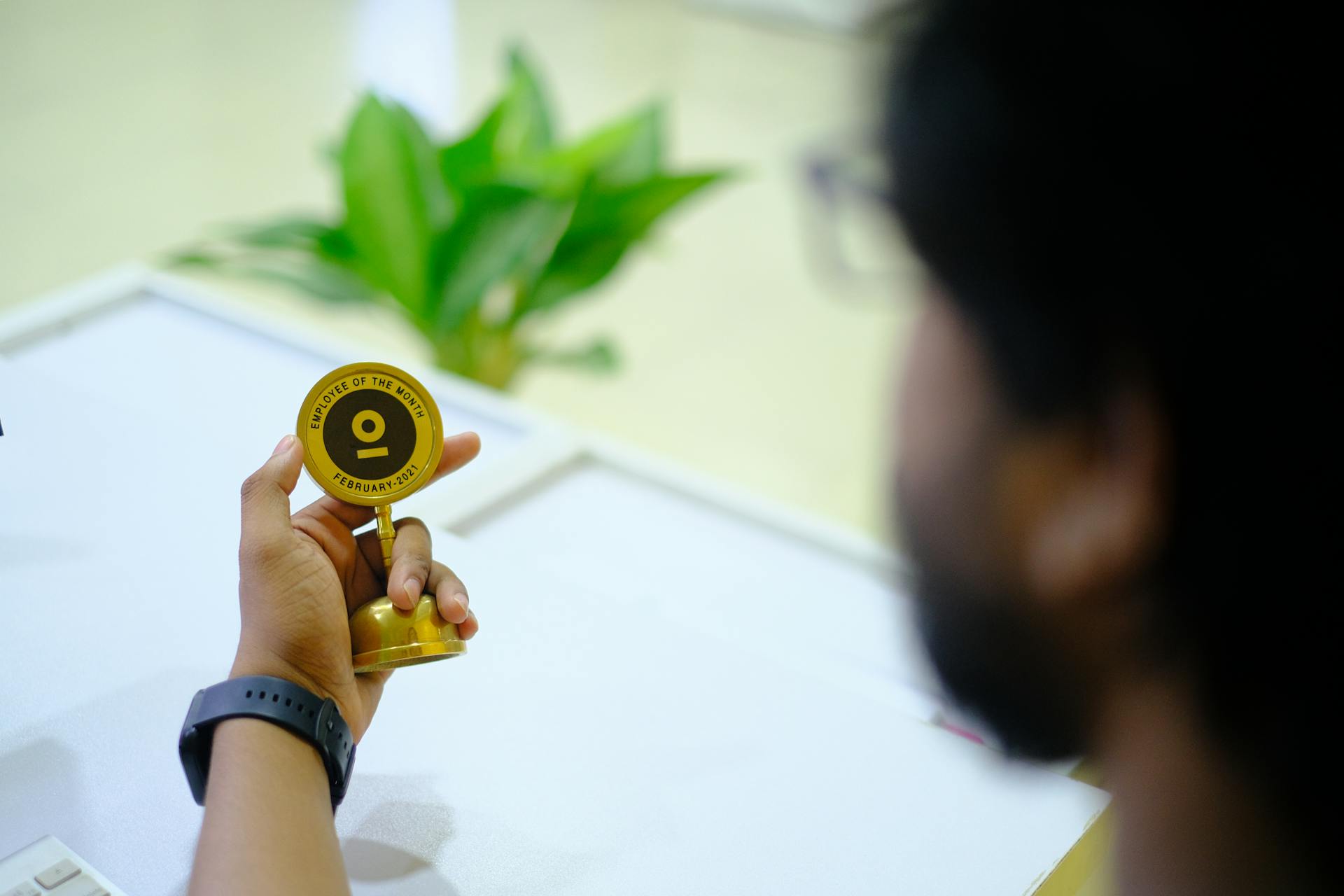
The Paris Kanellakis Award is a prestigious honor that recognizes outstanding contributions to algorithm engineering. It's awarded annually by ACM SIGACT and SIGMOD to individuals who have made significant impacts in the field.
One of the notable aspects of the Paris Kanellakis Award is its focus on algorithm engineering, a field that involves designing and analyzing algorithms for efficient problem-solving. The award celebrates the work of individuals who have developed innovative algorithms and data structures.
The Paris Kanellakis Award has been presented since 2003, and it's named after the late Paris Kanellakis, a renowned computer scientist who made significant contributions to the field of algorithm engineering. His work has had a lasting impact on the development of algorithms and data structures.
You might enjoy: IJCAI Computers and Thought Award
Paris Kanellakis Award
The Paris Kanellakis Theory and Practice Award is a prestigious honor that recognizes individuals who have made significant contributions to the field of computing. It's awarded by the Association for Computing Machinery (ACM) to innovators who have enabled the computing field to solve real-world challenges.
The award has been given to several notable individuals, including Michael Luby, who received the award in 2015 for his groundbreaking contributions to erasure correcting codes. These codes are essential for improving the quality of video transmission over the Internet.
Luby's work on erasure correcting codes has led to major advances in the reliable transmission and recoverability of data across mobile, broadcast, and satellite channels. His contributions have been applied to military technology as well as consumer devices in both wired and wireless networks.
James Demmel received the Paris Kanellakis Theory and Practice Award in 2014 for his work on numerical linear algebra libraries, including LAPACK. This software library is a standard tool for many vendors and enables users to transition their computer programs to new high-performance computers without starting from scratch.
The award is not just a recognition of individual achievements, but also a testament to the impact of their work on various fields, including computer vision, databases, and machine learning.
A different take: Epitech Paris
Award Recipients
The Paris Kanellakis Theory and Practice Award has been presented to numerous individuals and teams who have made significant contributions to the field of computer science. Michael Luby, a vice president of technology at Qualcomm Technologies, Inc., received the award in 2015 for his groundbreaking contributions to erasure correcting codes.
The award has also recognized teams of researchers for their work. In 2019, Noga Alon, Phillip Gibbons, Yossi Matias, and Mario Szegedy were honored for their pioneering work on the foundations of streaming algorithms and their application to large-scale data analytics. Their framework for algorithmic treatment of streaming massive datasets has had a profound impact on the field.
Guy E. Blelloch, Laxman Dhulipala, and Julian Shun received the award in 2022 for their contributions to algorithm engineering, including the Ligra, GBBS, and Aspen frameworks which revolutionized large-scale graph processing on shared-memory machines.
Intriguing read: List of Computer Science Awards
2017
In 2017, Scott Shenker was honored with the ACM Paris Kanellakis Theory and Practice Award.
Scott Shenker's work on fair queueing in packet-switching networks had a major impact on modern practice in computer communication. This work helped the internet grow from a tool used by a small community of researchers to a staple of daily life used by billions of people.
Shenker developed the first practical fair queueing algorithm for packet-switching networks, which provided equitable access to transmission bandwidth for different grades of service quality. Many commercial routers that make up the internet today use Shenker's algorithms.
Shenker also developed a mathematical tool for rigorous network research and introduced ideas for implementing "guaranteed" real-time services such as voice, video streaming, and multicasts.
2018
In 2018, Pavel Pevzner received the ACM Paris Kanellakis Theory and Practice Award.
The award was for his pioneering contributions to the theory, design, and implementation of algorithms for string reconstruction and their applications in genome assembly.
2019
In 2019, the ACM Paris Kanellakis Theory and Practice Award was given to Noga Alon, Phillip Gibbons, Yossi Matias, and Mario Szegedy.
These four researchers pioneered a framework for algorithmic treatment of streaming massive datasets, which remains the core approach for streaming big data today.
Their work laid the foundations of the analysis of data streams using limited memory, as seen in their seminal paper "The Space Complexity of Approximating the Frequency Moments".
This paper was instrumental in the development of the fields of streaming and sketching algorithms, which have been applied to various data analysis tasks, including query planning and processing in databases.
The concepts of sketches and synopses introduced by Alon, Gibbons, Matias, and Szegedy are now routinely used in various data analysis tasks, including databases, network monitoring, and natural language processing.
2022
The 2022 ACM Paris Kanellakis Theory and Practice Award went to Michael Burrows, Google, Paolo Ferragina, University of Pisa, and Giovanni Manzini, University of Pisa.
Their work on the Burrows-Wheeler Transform (BWT) revolutionized data compression. This transformation was used as the core of the compressor bzip2, which achieved compression performance superior to the standard of the time.
The BWT was first described in a 1994 paper by Michael Burrows and his late coauthor David Wheeler. It's amazing to think about how a single paper can have such a significant impact on the field of data compression.
The BWT was used as the core of the compressor bzip2, which became a widely used tool for data compression. Its effectiveness was a major breakthrough in the field.
Paolo Ferragina and Giovanni Manzini later built on the BWT by developing the FM-index, a compressed index that allowed for efficient queries. This was a major achievement, as it disproved the common belief that efficient queries came at a significant space penalty.
The FM-index has had a profound impact on the field of Data Compression and Computational Biology. It's now a premier indexing choice for software tools working on large collections of unstructured data.
2021
In 2021, the ACM Paris Kanellakis Theory and Practice Award was given to six researchers for their work on differential privacy.
The award recipients were Avrim Blum, Irit Dinur, Cynthia Dwork, Frank McSherry, Kobbi Nissim, and Adam Davison Smith.
Their contributions to differential privacy began to emerge in the early 2000's with several key papers, including a 2003 paper by Dinur and Nissim that showed certain techniques for answering queries can be inherently non-private.
The foundation for differential privacy was further developed through a sequence of papers by Dwork and Nissim in 2004 and by Blum, Dwork, McSherry, and Nissim in 2005.
These papers formed a definition of differential privacy that captures the kind of privacy needed in statistical settings, where individual information must be protected while still allowing for discovery of common trends.
The authors also showed that their definition includes post-processing and composition properties that facilitate design, analysis, and applications of differentially private algorithms.
The Laplace and the Gaussian noise mechanisms, which show differentially private analogs of statistical query learning algorithms, also grew out of the Kanellakis recipients’ work on differential privacy.
The award recipients’ work on differential privacy has led to practical deployments in industry and by the U.S. Census Bureau, among other applications.
Contributors to Algorithm Engineering
Guy E. Blelloch, Laxman Dhulipala, and Julian Shun received the ACM Paris Kanellakis Theory and Practice Award for their contributions to algorithm engineering.
Their work includes the Ligra, GBBS, and Aspen frameworks which revolutionized large-scale graph processing on shared-memory machines.
These frameworks have obtained many truly outstanding results in which their provably efficient algorithms running on an inexpensive multi-core shared-memory machine are faster than any prior algorithms, even those running on much bigger and more expensive machines.
They have been able to achieve this by designing algorithms that take advantage of the shared-memory architecture, making them more efficient and scalable.
Their work has had a significant impact on the field of algorithm engineering and has led to the development of more efficient and effective algorithms for large-scale graph processing.
These algorithms have numerous applications in fields such as social network analysis, recommendation systems, and network optimization.
Their contributions to algorithm engineering have paved the way for further research and development in this area, and their work continues to be widely used and cited in the field.
Submissions
To submit a nomination for the Paris Kanellakis Theory and Practice Award, you'll need to use the online nomination form. The most appropriate person to submit a nomination is a recognized member of the community who is not from the same organization as the candidate.
Guidelines for nominators and endorsers can be found on the ACM website. Each nomination involves several components, including the name, address, phone number, and email address of the nominator.
You'll also need to provide the name, address, and email address of the candidate, as well as a suggested citation, if selected. The citation should be a concise statement describing the key technical or professional accomplishment for which the candidate merits the award.
A nomination statement is also required, addressing why the candidate should receive the award. This statement should be between 200-750 words in length and draw particular attention to the contributions that merit the award.
In addition to the nomination statement, you'll need to provide a copy of the candidate's CV, listing publications, patents, honors, service contributions, and so on.
You'll also need to collect supporting letters from at least 3, and not more than 7, endorsers. Endorsers should be chosen to represent a range of perspectives and institutions and provide additional insights or evidence of the candidate's impact.
Here's a breakdown of the required components:
- Name, address, phone number, and email address of nominator (person making the nomination)
- Name, address, and email address of the candidate (person being nominated)
- Nomination statement (200-750 words in length) addressing why the candidate should receive this award
- Copy of the candidate's CV, listing publications, patents, honors, service contributions, etc.
- Supporting letters from at least 3, and not more than 7, endorsers
For questions on the above, please contact [email protected] or Jade Morris, ACM Awards Committee Liaison.
Featured Images: pexels.com