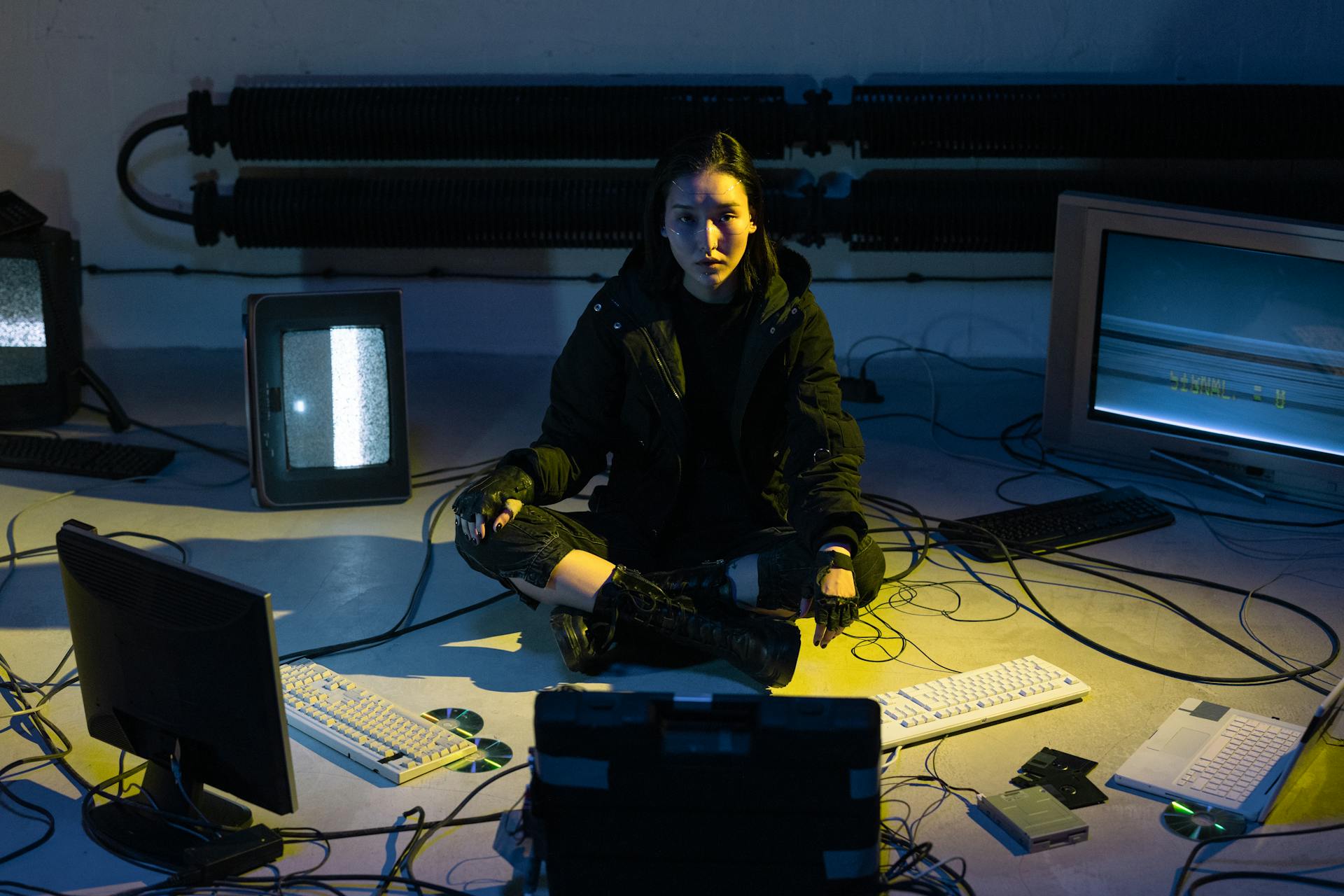
Turing Talk is a platform where experts in the field of AI and machine learning share their insights and experiences.
The intersection of hardware and software is a crucial aspect of AI development, as seen in the article section "The Evolution of AI Hardware". This section highlights the advancements in AI hardware, from traditional CPUs to specialized AI chips like TPUs and GPUs.
According to the article, these specialized chips have improved AI processing speeds by up to 100 times. This significant boost in speed enables faster training and deployment of AI models.
The combination of efficient hardware and software is what makes AI applications possible, as discussed in the article section "Software-Defined AI". This section explains how software frameworks like TensorFlow and PyTorch enable developers to build and deploy AI models on various hardware platforms.
Explore further: Konrad Zuse Medal
Awards and Recognition
The Turing Award is considered the "Nobel Prize for Computing" in the computing world.
Winning the Turing Award can have a significant impact on one's career, as it can lead to more invitations to give talks around the world.
It's a prestigious honor that makes you part of an "august body", which is a pretty cool feeling, as Patterson put it.
The Turing Award is a capstone achievement, meaning it's a culmination of a person's career, as Hennessy said.
Outstanding Dissertation Award
The Outstanding Dissertation Award is a prestigious honor that recognizes exceptional research in computer science.
Matt Sinclair of the University of Illinois at Urbana-Champaign won honorable mention for the 2018 ACM SIGARCH IEEE Computer Society TCCA Outstanding Dissertation Award.
Aasheesh Kolli of the University of Michigan received the 2018 ACM SIGARCH IEEE Computer Society TCCA Outstanding Dissertation Award.
Intriguing read: Turing Awards
Winning the Nobel Prize for Computing
Winning the Nobel Prize for Computing is a significant achievement in the computing world. It's considered the equivalent of winning the Nobel Prize.
The Turing Award is often referred to as the "Nobel Prize for Computing." This prestigious award is highly sought after by professionals in the field.
Receiving the Turing Award can open doors to new opportunities, such as giving talks around the world. Patterson and Hennessy have experienced this firsthand.
Winning the Turing Award is a capstone moment in one's career, marking a significant achievement. It's a moment to be proud of, especially when considering the esteemed group of winners.
Being part of the group of Turing Award winners is a touch of immortality. It's a lasting recognition of one's contributions to the field of computing.
Event Highlights
David A. Patterson, a retired Professor of UC Berkeley, delivered the Turing lecture at the 45th International Symposium on Computer Architecture, ISCA 2018. He was a co-winner of the 2017 Turing Award.
Ben Feinberg from the University of Rochester faced tough questions from the audience during the symposium. He spoke about enabling scientific computing on memristive accelerators.
The audience was told to "go easy on the tough questions" about Charles Eckert's paper, as it was his birthday.
The Lecture's Context
The Turing Lecture's context is fascinating. The lectures are a celebration of Alan Turing's contribution to computer science, which is still inspiring the next generation of computer scientists today.
Professor Jim Norton, the current BCS/IET Turing Champion, emphasizes the lectures' impact on young people. They fill the Belfast city hall with over 450 people, including students and young professionals from tech companies like Intel.
The lectures are an opportunity for young people to engage with the speaker and ask questions. Professor Norton notes that the best questions often come from young people, which is exactly what the organizers want.
The lectures are taking place in four cities this year: London, Cardiff, Dublin, and Belfast.
The Lecture's Content
The lecture will last approximately 2 hours, including an interval, and will cover the impact of AI on our daily lives and what this means for humanity.
The talk aims to provide a more nuanced understanding of AI's strengths and limitations, as well as the values and knowledge embedded in it.
Professor Shannon Vallor will explore how AI has become woven into the fabric of our daily existence, where it excels and where it falls short, and will remind us how AI is only as good as the data it is trained on.
She will also discuss the ramifications of this for those subject to its power and will provide insights on how we can harness AI's potential responsibly.
The lecture will be followed by a Q&A session, allowing attendees to engage with Professor Vallor and ask questions on the topic.
Lectures
The Turing Lectures are a series of talks that aim to inspire the next generation of computer scientists and provide a nuanced understanding of AI's strengths and limitations. Each lecture lasts approximately 2 hours, including an interval.
The lectures cover a range of topics, including the impact of AI on our daily lives, the ethics of AI, and the values and knowledge embedded in AI systems. Professor Shannon Vallor, the Baillie Gifford Chair in the Ethics of Data and Artificial Intelligence, will explore how AI has become woven into the fabric of our daily existence and the ramifications this has for those subject to its power.
The lectures are presented by The Alan Turing Institute, in partnership with Knowledge Quarter, and aim to equip attendees with a comprehensive understanding of the complex relationship between artificial intelligence and society. This series will ultimately help guide us towards a future where AI serves as a tool for progress, without compromising the core human elements that define our societies and interpersonal relationships.
This year's lectures will visit four cities - London, Cardiff, Dublin, and Belfast. Each lecture will include a Q&A session, allowing attendees to ask questions and engage with the speaker.
Here is the schedule for a typical Turing Lecture:
Hardware-Software Collaboration
Hardware and software teams need to work together more effectively. This is because the future of computing lies in parallel processing, not relying on single core improvements.
Many experts agree that single core processing isn't getting faster, and that's a fact. The free ride for software development is over, and hardware teams can no longer make up for subpar software.
Hennessy and Patterson, two award-winning experts, emphasized the need for better collaboration between hardware and software teams. They pointed out that software teams have relied too heavily on hardware to make up for their own shortcomings.
To achieve faster and lower energy computing, collaboration is essential. This means that software and hardware teams need to work together to create efficient and effective solutions.
Frequently Asked Questions
What was Alan Turing's famous quote?
Alan Turing's famous quote defines intelligence as the ability to deceive humans into thinking the computer is human. He also emphasized the importance of tackling the challenges ahead, despite limited visibility.
What did Alan Turing say about AI?
Alan Turing proposed a machine that can learn from experience and alter its own instructions, laying the groundwork for artificial intelligence. In a 1947 lecture, he envisioned a machine that could adapt and improve through self-modification.
What happened to Alan Turing?
Alan Turing was found dead at his home on June 8, 1954, due to cyanide poisoning, with the cause of death ruled as suicide.
Featured Images: pexels.com